Homemade Elderberry Syrup vs. Store-Bought: Which Is Right for You?
When exploring elderberry syrup, many families eventually ask the same question: Homemade elderberry syrup vs. store-bought, which is the better choice?
For some, making elderberry syrup at home is a meaningful tradition. There's something special about gathering ingredients, preparing a recipe, and knowing exactly what goes into the finished product.
For others, the convenience of a ready-to-use syrup is worth the investment, especially when it's made with the same thoughtful ingredients they would choose for themselves.
Neither approach is inherently right or wrong. The best choice depends on your priorities, preparation methods, available time, and what matters most to your family.
Let's explore the differences.
If you're new to elderberry, you may also enjoy our guide to 15 Facts About Elderberry Syrup Every Family Should Know
What Is Homemade Elderberry Syrup?
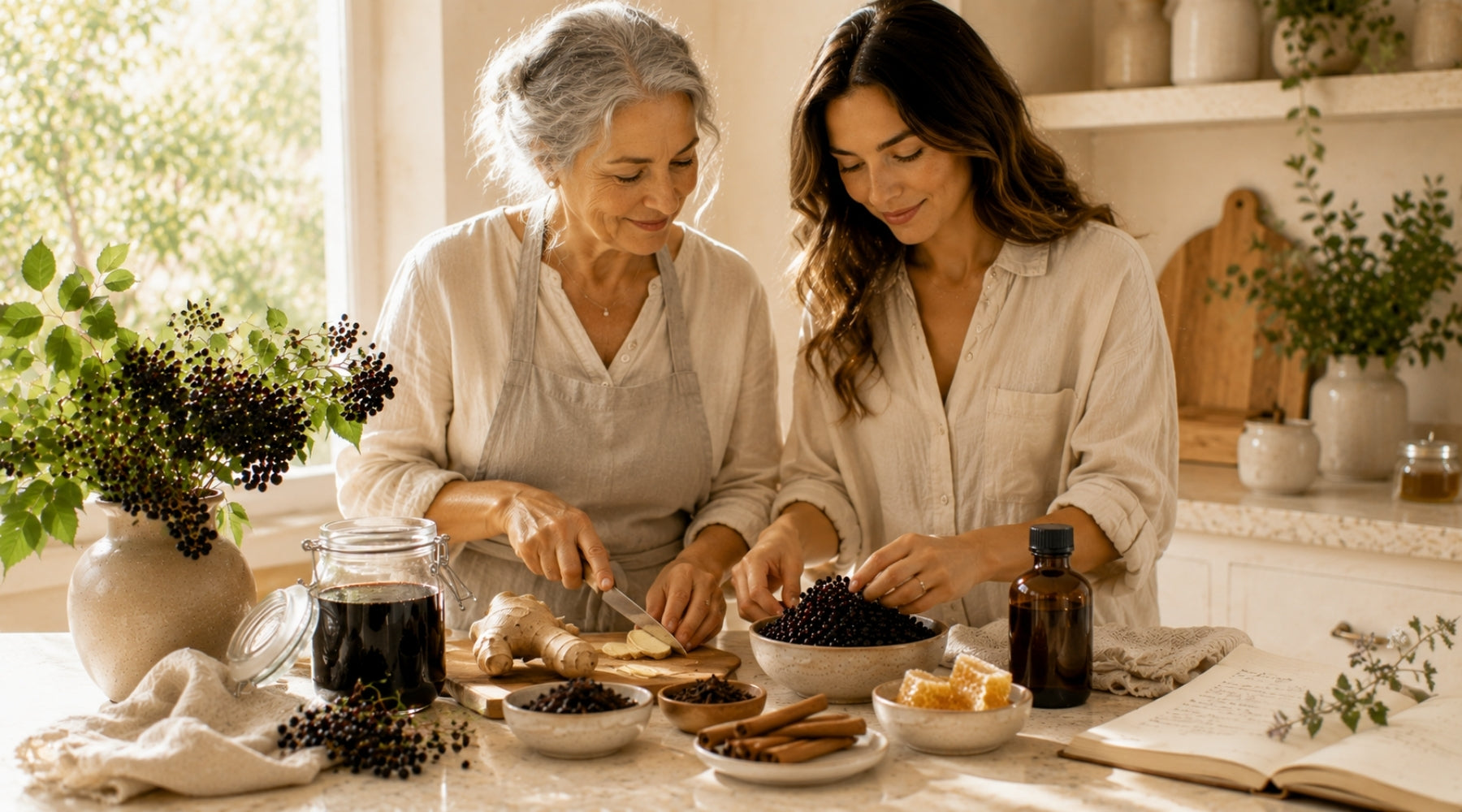
Homemade elderberry syrup is typically prepared by cooking elderberries in water, often with spices such as ginger, cinnamon, and cloves, before adding a sweetener such as honey.
Recipes vary considerably, but many include:
-
Dried or fresh elderberries
-
Water
-
Honey or another sweetener
-
Ginger root
-
Cinnamon
-
Cloves
For families who enjoy preparing foods from scratch, making elderberry syrup can be a rewarding experience.
It also offers flexibility in choosing ingredients and adjusting flavors to personal preference.
However, homemade elderberry syrup requires more than combining ingredients. Proper preparation, safe handling, and appropriate storage are important considerations. For additional safety information, visit the National Center for Complementary and Integrative Health's elderberry guide
The Benefits of Making Elderberry Syrup at Home
There are several reasons people enjoy preparing their own elderberry syrup.
You Choose the Ingredients
Making elderberry syrup at home gives you control over the ingredients you purchase and the recipe you follow.
You can select your preferred elderberry source, sweetener, and spices.
You Can Customize the Flavor
Some families prefer a stronger ginger flavor, while others enjoy a more pronounced cinnamon or clove profile.
Homemade recipes allow for personal adjustments.
You Enjoy the Preparation Process
For some people, preparing elderberry syrup is part of a larger interest in traditional foods, cooking, and hands-on wellness routines.
The experience itself can be meaningful.
You Can Make the Amount You Need
Homemade preparation allows you to choose your batch size, although safe storage and the recipe's usable shelf life should guide how much you make.

What Are the Challenges of Homemade Elderberry Syrup?
While making elderberry syrup at home has its appeal, there are practical considerations.
Time and Preparation
A homemade batch requires sourcing ingredients, measuring, cooking, straining, cooling, transferring, and cleaning up.
For busy households, that time commitment can be significant.
Consistency Between Batches
Even when following the same recipe, homemade batches may vary in flavor, concentration, texture, and yield.
Differences in elderberry sources, ingredient measurements, and preparation methods can affect the finished syrup.
Ingredient Sourcing
Finding high-quality elderberries and spices requires some research.
You'll want to know what variety of elderberries you're purchasing and whether the ingredients are appropriate for food preparation.
Storage and Shelf Life
Homemade elderberry syrup generally requires careful refrigeration and handling.
Because recipes differ in ingredients, acidity, preparation, and sanitation, there is no universal shelf life that applies to every homemade syrup.
Is Homemade Elderberry Syrup Safe?
This is one of the most important considerations when comparing homemade elderberry syrup vs. store-bought products.
Raw or improperly prepared elderberries and certain other parts of the elder plant can contain naturally occurring compounds that may cause nausea, vomiting, or diarrhea.
Proper identification and preparation are essential.
If you choose to make elderberry syrup at home, use an appropriate food-safe recipe from a reliable source, ensure the elderberries are properly cooked, and follow safe handling and storage practices.
Avoid using unripe berries, leaves, stems, or other plant parts not intended for consumption.
It's also important to remember that honey should never be given to infants under 12 months of age.
Making elderberry syrup at home can be a rewarding process, but food safety should always come first.
What Are the Benefits of Store-Bought Elderberry Syrup?
If you're comparing homemade and store-bought options, our guide to Choosing an Elderberry Product offers additional considerations for evaluating ingredients, preparation methods, and quality.
Store-bought elderberry syrup offers a ready-to-use option without the preparation involved in making it yourself.
Depending on the brand, advantages may include:
-
Convenience and time savings
-
Consistent formulation
-
Established serving recommendations
-
Labeled storage instructions
-
Manufacturing quality controls
-
Product testing and documentation
However, not every commercially prepared elderberry syrup follows the same standards.
Some products are made using extracts or concentrates. Others begin with whole elderberries. Ingredient lists, sweeteners, manufacturing methods, and storage requirements can also vary.
When purchasing elderberry syrup, it's worth understanding how a particular brand approaches these details.
Homemade Elderberry Syrup vs. Store-Bought: A Side-by-Side Comparison
| Consideration | Homemade Elderberry Syrup | Store-Bought Elderberry Syrup |
|---|---|---|
| Ingredients | Selected by the person preparing the recipe | Determined by the manufacturer |
| Preparation | Requires cooking, straining, and handling | Ready to use |
| Consistency | May vary between batches | Formulated for consistency |
| Quality controls | Depend on home preparation practices | Vary by manufacturer |
| Testing | Generally not independently tested | May include third-party testing |
| Storage | Depends on recipe and preparation | Product-specific labeled instructions |
| Cost | Ingredients, equipment, time, and yield | Purchase price, servings, and shipping |
| Convenience | Requires planning and preparation | Available when needed |
Neither option automatically guarantees better quality or effectiveness.
The important distinction is how carefully the product is prepared, whether its ingredients and storage practices are appropriate, and whether it meets your family's needs.
Is Homemade Elderberry Syrup Cheaper Than Store-Bought?
Homemade elderberry syrup may cost less per batch, but the comparison is not always straightforward.
To understand the true cost, consider:
-
Elderberries and other ingredients
-
Honey and spices
-
Equipment and preparation supplies
-
Time spent preparing and cleaning
-
Finished yield
-
Storage requirements
-
Potential waste from unused syrup
With store-bought syrup, you can compare the price per serving, ingredients, manufacturing practices, and shipping costs.
For some households, homemade preparation may be the more economical choice.
For others, the convenience of a prepared product and the time saved may make purchasing a quality syrup worthwhile.
How Long Does Homemade Elderberry Syrup Last?
Homemade elderberry syrup does not have one universally established shelf life.
Its storage life depends on the recipe, ingredient proportions, cooking method, sanitation, packaging, and refrigeration conditions.
Commercially manufactured syrups may have product-specific shelf-life guidance supported by their manufacturing and quality procedures.
At The POWER of Elderberries®, our Signature Elderberry Syrup requires refrigeration upon arrival and should be consumed by the best-by date printed on the bottle or within 90 days of opening, whichever comes first.
If you would like to learn more about proper storage, our guide How Long Does Elderberry Syrup Last? (Storage, Shelf Life & Freshness Guide) explains what families should know.
Our Story Began With Homemade Elderberry Syrup
At The POWER of Elderberries®, we understand the appeal of homemade elderberry syrup because that's exactly where our story began.
Preparing elderberries for family use is a tradition that stretches back generations. Long before elderberry syrup became a familiar wellness product, families were cooking elderberries into syrups, preserves, and seasonal recipes. Explore Chapter Two: The History of Elderberries to discover more about the traditions behind this remarkable fruit.
Long before there was a manufacturing facility, nationwide shipping, or third-party laboratory testing, there was a mother preparing elderberry syrup in her own kitchen for her family.
What began as a personal recipe eventually became something we wanted to share with other families.
Today, that same whole-food philosophy remains at the heart of our Signature Elderberry Syrup.
We begin with five carefully selected ingredients:
-
Organic European black elderberries (Sambucus nigra)
-
Organic ginger root
-
Organic cinnamon sticks
-
Organic whole cloves
-
Local raw honey
Our whole elderberries and organic spices are slowly simmered in purified water. After the mixture cools, we add local raw honey.
We don't use elderberry concentrates, refined sugar, artificial sweeteners, fillers, thickeners, dyes, or preservatives.
Every batch is handcrafted in our FDA-registered manufacturing facility, which has been inspected by the FDA, and our products undergo third-party laboratory testing.
We refrigerate our syrup after production and cold ship it directly to our customers.
In many ways, we're still making the elderberry syrup that began in our family kitchen. We've simply created a way to share it with yours.

Why Families Choose Our Handcrafted Elderberry Syrup
For families who appreciate homemade ingredients but don't always have time to prepare elderberry syrup themselves, our Signature Elderberry Syrup offers a thoughtfully crafted alternative.
Our approach combines:
-
A traditional whole-berry preparation method
-
Five recognizable whole-food ingredients
-
Small-batch craftsmanship
-
Third-party testing
-
Established storage and serving guidance
-
A rich, smooth flavor families enjoy
We believe convenience shouldn't require giving up the ingredient standards that matter to you.
Our goal has never been to replace the joy of homemade traditions.
It's to make a carefully prepared, whole-food elderberry syrup accessible to families who value those traditions but prefer the convenience of a ready-to-use product.
Which Is Better: Homemade or Store-Bought Elderberry Syrup?
The answer depends on your priorities.
Homemade elderberry syrup may be a good fit if you:
-
Enjoy cooking and preparing traditional recipes
-
Want to select and customize ingredients yourself
-
Have the time and knowledge to prepare and store it safely
-
Appreciate the experience of making something from scratch
Store-bought elderberry syrup may be a good fit if you:
-
Prefer something ready to use
-
Value consistent formulation and clear serving directions
-
Want to review manufacturing and testing information
-
Have a busy schedule
-
Prefer not to prepare new batches at home
For families who appreciate both approaches, a professionally prepared, small-batch syrup can offer a welcome middle ground.

Final Thoughts
When comparing homemade elderberry syrup vs. store-bought, there isn't one answer that fits every family.
Homemade preparation offers flexibility and a meaningful hands-on experience. Store-bought syrup offers convenience, consistency, and, depending on the manufacturer, additional quality controls.
What matters most is understanding the ingredients, preparation methods, safety considerations, storage requirements, and overall value.
At The POWER of Elderberries®, we're proud that our story began with a homemade recipe and continues today through the same commitment to whole-food ingredients and thoughtful craftsmanship.
If you're looking for a handcrafted elderberry syrup prepared with care, explore our Signature Elderberry Syrup collection and discover the option that fits your family's routine.
Common Questions About Homemade vs. Store-Bought Elderberry Syrup
Is homemade elderberry syrup better than store-bought?
Not necessarily. Homemade syrup offers ingredient customization and hands-on preparation, while commercially prepared products may offer greater convenience, standardized formulations, and manufacturing quality controls. Quality depends on the specific recipe or product.
Is homemade elderberry syrup safe?
Homemade elderberry syrup requires proper identification, cooking, handling, and storage. Raw or improperly prepared elderberries can contain compounds that cause gastrointestinal symptoms. Follow a reliable food-safe recipe.
Is store-bought elderberry syrup healthier than homemade?
There is insufficient evidence to conclude that homemade or commercially prepared elderberry syrup is universally healthier. Ingredients, preparation, serving sizes, and quality practices vary.
Is homemade elderberry syrup cheaper?
It can be, depending on ingredient costs, batch yield, equipment, and preparation time. Comparing cost per serving provides a more useful picture than comparing the price of one homemade batch with a retail bottle.
How long does homemade elderberry syrup last?
Shelf life depends on the recipe, preparation method, sanitation, and storage conditions. There is no universal refrigerated shelf life for all homemade elderberry syrups.
Does store-bought elderberry syrup contain preservatives?
Some products do, while others do not. Read the complete ingredient list. The POWER of Elderberries® Signature Elderberry Syrup contains no added preservatives and requires refrigeration.
FDA Disclaimer
These statements have not been evaluated by the Food & Drug Administration. This content is for educational purposes only and is not intended to diagnose, treat, cure, or prevent any disease.