CHAPTER FOUR: POTENTIAL BENEFITS
The Complete Guide to Elderberries → Chapter Four
What research and traditional use can teach us.
In This Chapter
What can elderberries actually do?
It's one of the most common questions people ask and one that deserves a thoughtful answer.
Elderberries have been appreciated for generations, but today's interest goes far beyond tradition. Researchers have studied European black elderberry (Sambucus nigra) and its naturally occurring plant compounds to better understand their biological activity and why this small, deeply colored fruit continues to attract scientific attention.
While elderberries aren't a cure-all, research has explored their potential role in supporting immune function, antioxidant activity, respiratory wellness, and the body's natural inflammatory response. Understanding what the research does and does not tell us can help families separate thoughtful wellness choices from exaggerated claims.
By the end of this chapter, you'll understand:
✓ Why elderberries are often associated with immune wellness
✓ What antioxidants and anthocyanins have to do with elderberries
✓ What research has explored during times of seasonal illness
✓ Why preparation, dosage, and product quality matter when interpreting research
Elderberries and Immune Support
Perhaps the best-known association with elderberries is immune wellness.
European black elderberries naturally contain anthocyanins, flavonoids, and other polyphenols, the same broad families of plant compounds found throughout many deeply colored fruits and vegetables. These compounds
have attracted scientific interest because of their antioxidant activity and potential relationship with normal immune function.
The immune system itself is remarkably complex. Rather than thinking of an ingredient as simply "boosting" immunity, it is more accurate to think about supporting the body's normal immune processes.
For a closer look at what researchers have learned about elderberry and immune wellness, explore Elderberry Benefits: What It’s Commonly Used For & What Research Tells Us.
This distinction matters.
Nutrition, sleep, movement, hydration, stress management, and other everyday habits all contribute to overall wellness. Elderberry can be one part of that larger picture rather than a replacement for the fundamentals that help support a healthy body.
"Wellness isn't built around one ingredient. It's built through the small choices we make consistently."
The Antioxidants Behind Elderberries' Deep Purple Color
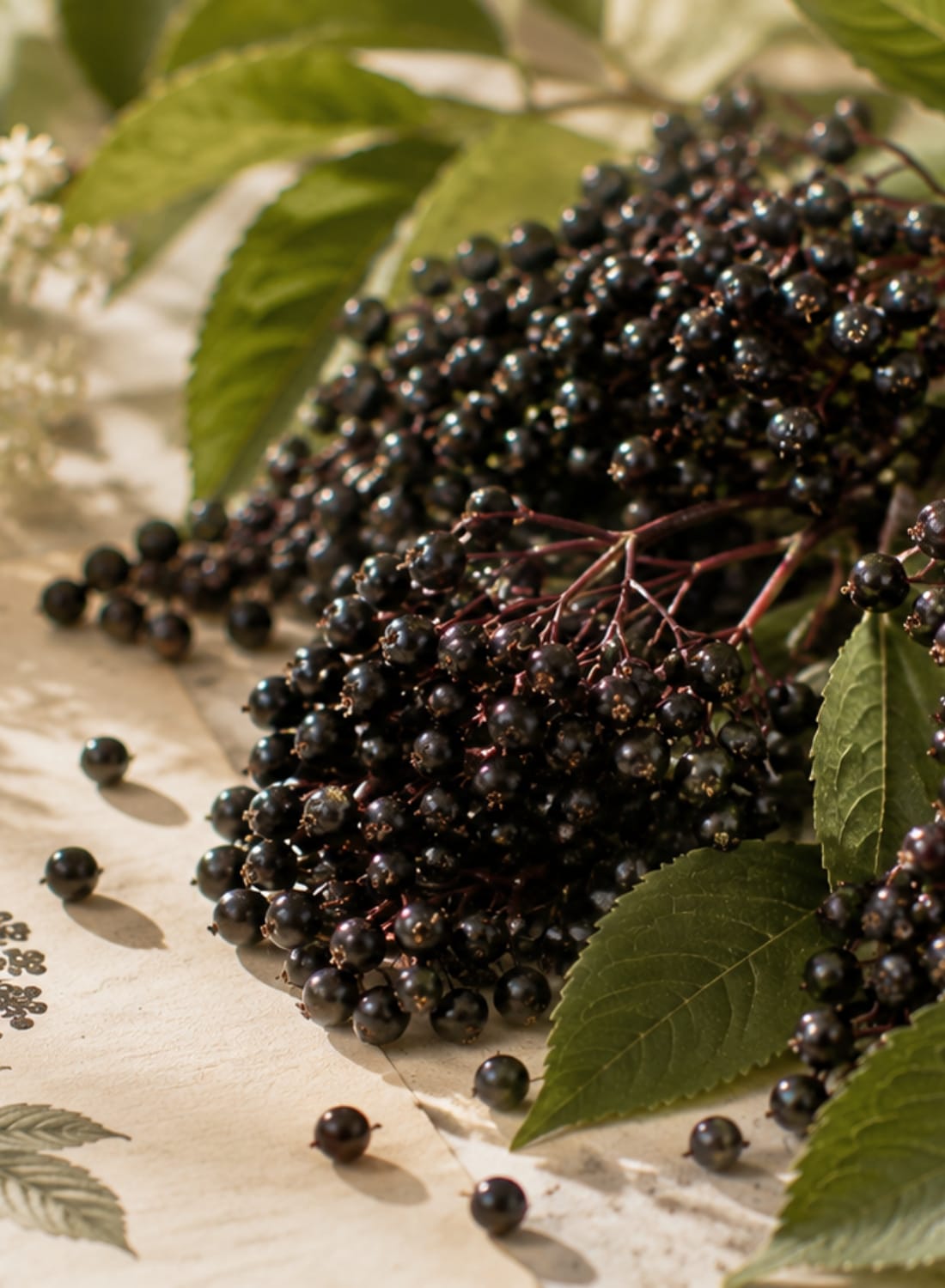
One of the most fascinating things about elderberries is visible before you ever taste one: their color.
The rich purple-black color of ripe elderberries comes largely from naturally occurring pigments called anthocyanins. Anthocyanins belong to a larger family of plant compounds known as flavonoids
and are found in many deeply colored foods, including blueberries, blackberries, cherries, purple cabbage, and elderberries.
Researchers study these compounds in part because of their antioxidant properties. In laboratory settings, antioxidants can interact with unstable molecules known as free radicals. However, identifying antioxidant activity in a plant compound does not automatically establish a particular health benefit from consuming an elderberry product.
Rather than making elderberries extraordinary simply because they contain antioxidants, it is more useful to recognize them as one particularly rich and interesting source of naturally occurring plant compounds.
This is also one reason the variety, sourcing, and preparation of elderberries continue to receive attention in scientific
research.
What Research Has Explored During Seasonal Illness
This is where elderberry research has received some of its greatest attention.
Several clinical studies and research reviews have investigated elderberry preparations in relation to upper respiratory symptoms, particularly when taken around the onset of seasonal illness. Some studies have reported promising findings related to the duration or severity of symptoms, while the overall body of evidence remains limited and continues to evolve.
That distinction is important.
Individual studies don't prove that every elderberry product will produce the same result. Different studies may use different elderberry preparations, concentrations, serving amounts, participant groups, and study designs.
This is why phrases such as "elderberry cures the flu" or "elderberry prevents colds" go far beyond what the evidence supports.
A more accurate takeaway is that elderberry has been studied for its potential role in supporting wellness during times of seasonal respiratory challenges, and the findings have been interesting enough to encourage continued scientific research.
For a closer look at the research surrounding seasonal respiratory symptoms, read Does Elderberry Help With Colds? What Families Should Know.
As with any botanical ingredient, the details matter. Research should be interpreted within the context of the specific preparation that was actually studied.
Elderberries and Research Into Inflammatory Processes
Inflammation is another area that can easily become misunderstood in wellness conversations.
The body's inflammatory response isn't inherently bad. In fact, it is a normal and necessary biological process that helps the body respond to everyday stressors.
Researchers have investigated polyphenol-rich foods, including elderberries and other deeply pigmented fruits, for their relationship with oxidative stress and pathways involved in normal inflammatory processes.
This doesn't mean elderberries should be viewed as a treatment for inflammatory conditions. Rather, their naturally occurring plant compounds are one reason they continue to be studied as part of broader conversations about nutrition, antioxidants, and whole-body wellness.
The distinction between supporting a healthy inflammatory response and treating inflammation or disease is an important one and something worth remembering whenever evaluating wellness claims.
Why the Research Doesn't Apply Equally to Every Elderberry Product
There's another important piece of the conversation that often gets overlooked.
When researchers study elderberry, they aren't studying every elderberry product on the shelf.
A study may evaluate a particular elderberry species, preparation, concentration, serving amount, or formulation. That doesn't automatically mean the findings can be applied to every syrup, gummy, capsule, powder, or extract marketed as "elderberry."
This is why reading beyond the front of the package matters.
Questions worth considering include:
- Which elderberry species is used?
- How much elderberry does the product contain?
- Is the elderberry derived from whole berries, concentrate, powder, or extract?
- What other ingredients are included?
- How is the product prepared?
- Does the company clearly explain what you're purchasing?
Research gives us valuable information, but understanding the product in your own hands provides equally important context.
Understanding these differences is an important part of making informed choices. In Chapter Six: Choosing an Elderberry Product, we'll explore what to look for on ingredient labels, how preparations differ, and which questions can help families compare products with greater confidence.
A Note from Jessica
One of the reasons I care so deeply about education is that elderberry is sometimes talked about as though it can do everything.
I don't believe we need to make extraordinary promises for elderberries to be extraordinary.
What fascinated me years ago, and still fascinates me today, is that this tiny, deeply colored berry has been valued for generations and continues to be studied by modern researchers. There is so much beauty in simply understanding what nature provides without turning it into something it isn't.
When families ask me what elderberry can do, I want them to have information they can trust, understand, and use to make their own thoughtful decisions.
That's what I hope this guide provides.
— Jessica Lowery, M.A.T.
Founder, The POWER of Elderberries®
Putting the Research Into Perspective
So, what should we take away from all of this?
Elderberries contain naturally occurring plant compounds that have made them interesting to researchers, particularly in areas involving antioxidant activity, immune function, and seasonal wellness.
At the same time, research has limitations. Study sizes vary. Preparations differ. Scientific understanding continues to evolve.
That doesn't diminish elderberries' value. It simply helps us appreciate them with appropriate perspective.
Traditional use gives us history.
Modern science gives us another way to explore that history.
And thoughtful education helps connect the two.
The goal isn't to turn elderberries into a miracle ingredient. It's to understand what we know, recognize what we're still learning, and make informed decisions about how they may fit into a broader approach to everyday wellness.
Research & References
The science surrounding elderberries continues to evolve. The research below includes clinical studies and scientific reviews exploring European black elderberry (Sambucus nigra), its naturally occurring plant compounds, and its potential relationship with seasonal and respiratory wellness. Individual studies may evaluate specific elderberry extracts, preparations, serving amounts, or populations, so their findings should not be assumed to apply equally to every elderberry product.
References
Hawkins, J., Baker, C., Cherry, L., & Dunne, E. (2019). Black elderberry (Sambucus nigra) supplementation effectively treats upper respiratory symptoms: A meta-analysis of randomized, controlled clinical trials. Complementary Therapies in Medicine, 42, 361–365. This meta-analysis included 180 participants across randomized controlled trials and reported reductions in upper-respiratory symptoms, while also noting the limited scale of the available research.
Tiralongo, E., Wee, S. S., & Lea, R. A. (2016). Elderberry supplementation reduces cold duration and symptoms in air-travellers: A randomized, double-blind placebo-controlled clinical trial. Nutrients, 8(4), 182. In this 312-person trial, elderberry did not significantly reduce the number of participants who developed colds, but among those experiencing cold episodes, the elderberry group had shorter duration and lower symptom scores. The researchers stated that additional research was warranted.
Zakay-Rones, Z., Thom, E., Wollan, T., & Wadstein, J. (2004). Randomized study of the efficacy and safety of oral elderberry extract in the treatment of influenza A and B virus infections. Journal of International Medical Research, 32(2), 132–140.This small randomized, double-blind, placebo-controlled trial of 60 participants reported earlier symptom relief among those receiving the elderberry preparation. The authors specifically noted that the findings needed confirmation in a larger study.
Macknin, M., et al. (2020). Elderberry extract outpatient influenza treatment for emergency room patients ages 5 and above: This randomized, double-blind, placebo-controlled trial of 87 participants did not find a significant benefit of elderberry extract for influenza symptom duration or severity.
Sidor, A., & Gramza-Michałowska, A. (2015). Advanced research on the antioxidant and health benefit of elderberry (Sambucus nigra) in food—a review. For the plant-compound portion of the chapter, broader scientific reviews document Sambucus nigra as a source of phenolic compounds and anthocyanins, including cyanidin derivatives. More recent reviews likewise describe elderberry's substantial anthocyanin/polyphenol content and discuss antioxidant activity.
Wieland, L. S., et al. (2021). Elderberry for prevention and treatment of viral respiratory illnesses: a systematic review. BMC Complementary Medicine and Therapies, 21, 112. This systematic review evaluated five randomized trials involving elderberry and viral respiratory illness. The authors concluded that elderberry may reduce the duration or severity of some respiratory symptoms, but the evidence remains uncertain and additional research is needed.
Additional Educational Resource
National Center for Complementary and Integrative Health — Elderberry: Usefulness and Safety The National Center for Complementary and Integrative Health (NCCIH), part of the National Institutes of Health, provides an overview of current elderberry research and safety information. NCCIH notes that a small number of studies have evaluated elderberry for colds, flu, and other upper respiratory infections, with some preliminary research suggesting potential symptom relief.
Closing Research Note
Research on elderberries is ongoing, and findings vary depending on the elderberry species, preparation, concentration, study population, and research design. The information presented throughout this guide is educational and is not intended to diagnose, treat, cure, or prevent disease.
Continue Learning
Want to explore these topics in greater depth? These related articles expand on the research, everyday wellness considerations, and questions introduced throughout this chapter.
- What Is Elderberry Good For? How Families Use It in Everyday Wellness
- What Does Elderberry Do?
- Which Elderberry Is Best for Immune Support? A Simple Guide for Choosing Wisely
Looking for all educational articles? Browse the complete article library.
Continue Reading
Continue your journey through The Complete Guide to Elderberries.